Access to shared open knowledge constructed in a collaborative way is mission-critical for the future of AI, especially since non-AI-generated content is expected to be surpassed in size by synthetic, AI-generated content in the coming period. The importance of it has also been highlighted by the Turing Award winner in the field of Deep Learning, Yann LeCun:
“The way you train that (AI) system will have to be crowdsourced … if you want it to be a repository of all human knowledge, all humans need to contribute to it.” Yann LeCun
To achieve that, AI para — networks or paranets, the autonomously operated collections of Knowledge Assets owned by its communities and residing on the OriginTrail Decentralized Knowledge Graph (DKG), were introduced in the Whitepaper 3.0.
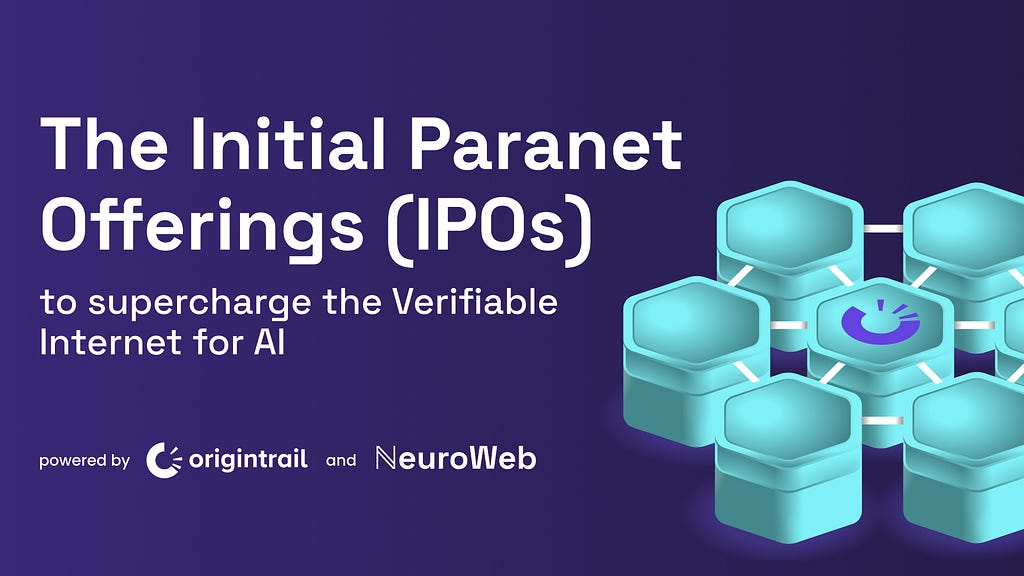
Initial Paranet Offerings (IPO) are now introduced as a means of a public launch of a paranet, with a collection of Knowledge Assets and accompanying incentivization structure proposed and voted upon via the NeuroWeb governance mechanism. Each IPO is structured as an initial proposal and an initial set of Knowledge Assets published, along with an incentivization structure set forth by an IPO operator that proposes how the incentives will be split across three groups:
- IPO operator
- Knowledge miners
- Neuro holders that participated in supporting the creation of an IPO and approved the requested allocation of Neuro utility tokens for an IPO’s knowledge mining.
The success of an IPO largely depends on the IPO’s operator ability to wisely propose the incentive structure, taking into consideration the following factors among others:
- IPO operator autonomously selects AI services to be used to drive value of a knowledge base, and must undertake an economically and commercially viable approach for both creation and maintenance of a paranet. It is expected that an IPO operator proposes an operator fee that renders the birth of a paranet economically viable (earning a share of allocated emissions), while also setting up a fee structure for both knowledge miners and NEURO holders that partake in voting.
- Assuming the cost of mining Knowledge Assets on the DKG in TRAC utility tokens, knowledge miners are to be considered as central to the success of not only an IPO proposal, but even more so as entities that drive incentives in NEURO tokens only as each new knowledge asset is mined. Only when new Knowledge Assets are mined, the allocated emissions of NEURO are executed across the three groups as incentives. When launching an IPO, the paranet operator will define the ratio of NEURO to be earned per TRAC spent to mine each Knowledge Asset. An IPO operator may set the ratio autonomously to target a desired profitability before the proposal is submitted to voting, yet attempts of price gouging might not receive support from NEURO holders.
- NEURO holders that support an IPO via governance voting are to lock up tokens for the duration of NEURO emission allocated for the IPO. Though the share of emissions allocated for an IPO is an important factor for NEURO holders’ decision, the duration of the “lock period” can also play an important role. The paranet operator also defines what portion of paranet incentives will be shared with NEURO holders supporting the proposal.
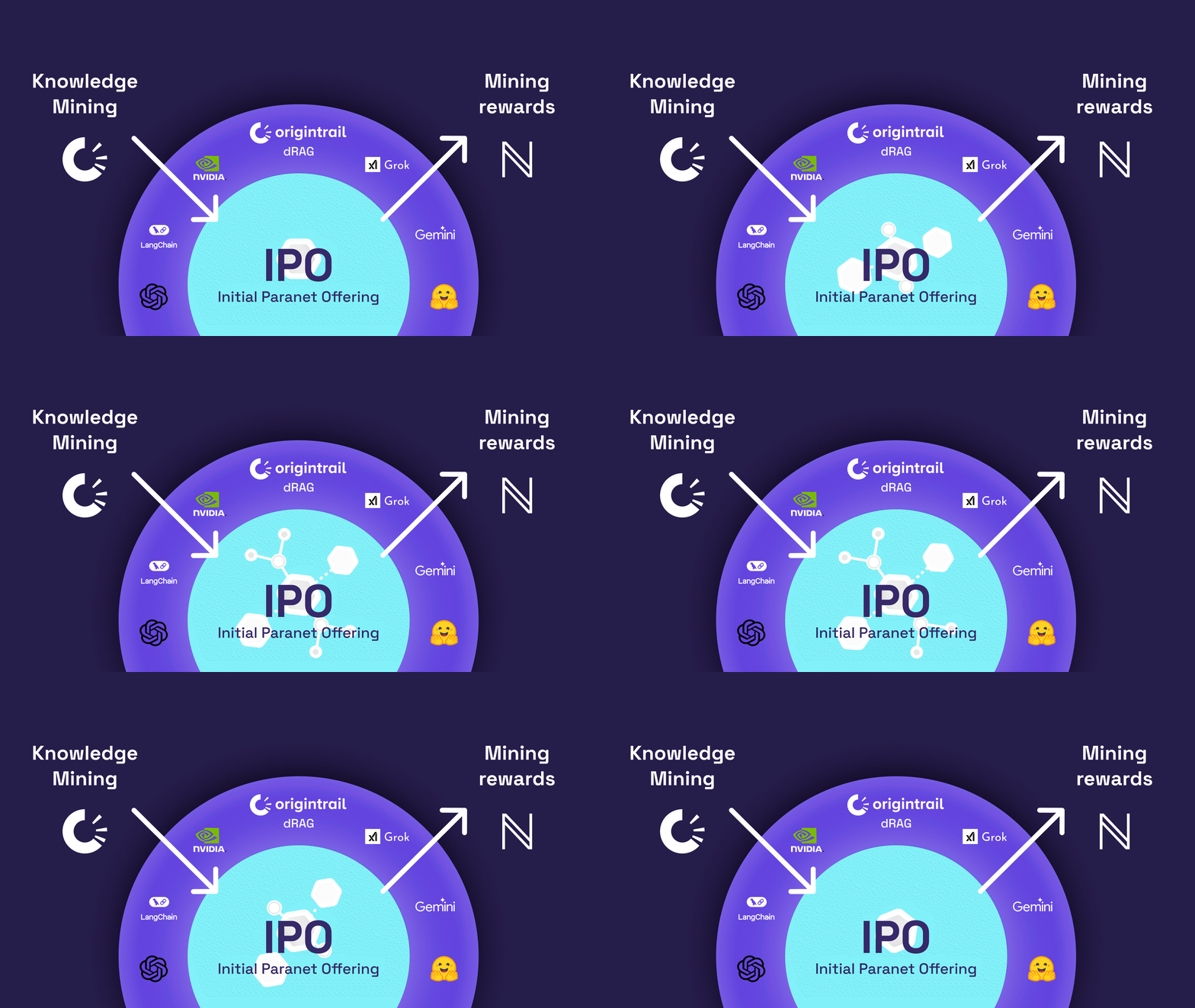
The ecosystem incentivizing the Verifiable Internet for AI
The interest to launch the first IPOs has already been pre-registered by several institutional entities and builders, with the inaugural batch nearing the announcement stage. If you are interested in launching a paranet and knowledge mining, hop into the community discussion in Discord and share your ideas.