AI agents are exploding in use across industries, but they’re roaming a digital world with no shared identity or trust framework. Today, an agent can claim “I can code” or “I can trade” (“trust me, bro, I’m an AI agent”), yet there’s no standard way to verify if any of it is true.
You wouldn’t trust strangers operating like that, and neither can AI agents truly trust each other under these conditions. This “trust gap” is a major roadblock to an open agent economy. Agents need a way to carry their identity, context, and track record with them — something akin to a passport — so they can be discovered and trusted by others at machine speed.
Giving AI agents a Digital Passport with ERC‑8004 and Decentralized Knowledge Graph
Combining the ERC‑8004 standard with the OriginTrail Decentralized Knowledge Graph (DKG) creates a powerful synergy akin to giving AI agents a digital passport from day one. ERC‑8004 establishes an agent’s on-chain identity and structure — essentially issuing a standardized passport number and “photo page” for the AI — while the OriginTrail DKG fills that passport with dynamic, verifiable context, i.e., the stamps, visas, certificates, and travel history that accumulate as the agent interacts and learns. Together, these technologies ensure each AI agent has both a trusted identity and a rich, evolving track record of its accomplishments, all secured by blockchain and cryptographic proofs.
The ERC‑8004 Ethereum standard gives every AI agent a unique on-chain identity. Each agent is issued an ERC-721 NFT as its “passport document,” providing a portable, censorship-resistant identifier on Ethereum. This identity token (the agent’s “passport number”) links to a registration file describing the agent’s core info — for example, its capabilities, endpoints (how to communicate with it), and even aspects of its “social graph” or affiliations. In other words, ERC‑8004 standardizes how an AI agent presents itself, ensuring that anyone, anywhere, can verify who the agent is and what skills it claims to have. Just as a real passport is issued by a trusted authority, the ERC‑8004 identity is anchored on Ethereum, making it globally verifiable and hard to forge. This on-chain identity layer also includes built-in trust anchors: ERC‑8004 defines reputation and validation registries that record an agent’s on-chain feedback and certifications, functioning like official seals or endorsements on a passport.
Thanks to ERC-8004, AI agents now have a basic passport — a way to present who they are and what they’ve done in a standard, verifiable format. An agent that wants to be hired for a job can show their ERC-8004 credentials: “Here’s my ID and resume, here are my reviews, and here are proofs of my capabilities.” In fact, the standard explicitly frames the identity NFT as the agent’s passport.
However, like a freshly issued real-world passport, this is just the beginning. The passport, by itself (an NFT plus a static JSON file), is necessary but not sufficient for rich trust. It tells you the basics, but imagine if we could stuff that passport with far more context — every stamp, visa, reference letter, and credential an agent earns over time, in a way that’s trusted and queryable. This is where OriginTrail Decentralized Knowledge Graph comes in, turning the passport into something much more powerful.
Decentralized Knowledge Graph: Turning the passport into a living context graph
OriginTrail Decentralized Knowledge Graph (DKG) steps in to supercharge ERC-8004’s static records, effectively transforming an agent’s passport into a living, verifiable context graph. Think of ERC-8004 as issuing the agent a blank passport and a basic ID card; the DKG is what brings that passport to life with data, continuously updated with verified stamps and stories of the agent’s journey. In OriginTrail’s own words, the DKG serves as a “constantly evolving digital passport for agents,” essentially an agent-specific context graph that grows over time with each interaction
How does it work?
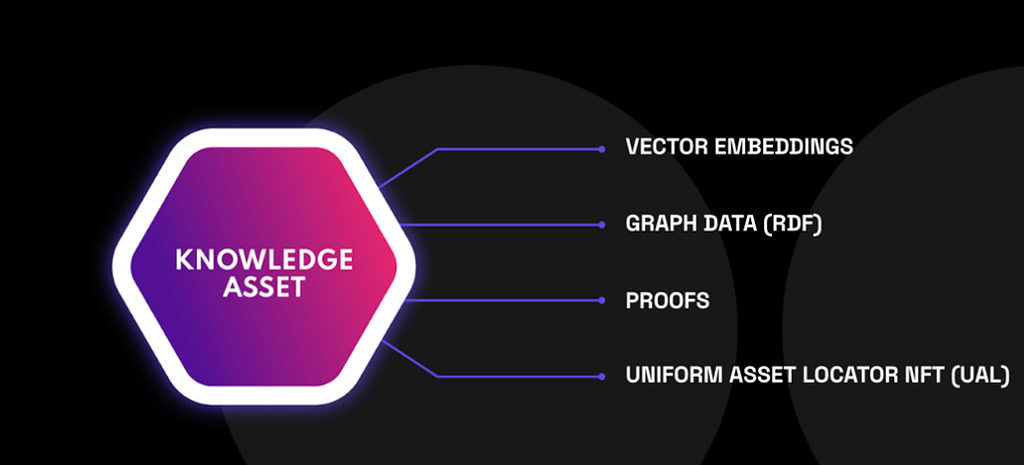
The DKG is a decentralized network designed to store and publish structured knowledge (using semantic web standards) with verifiable provenance. In the DKG, information is not just dumped in JSON files or logs — it’s represented as a knowledge graph: a web of facts and relationships that machines can easily query and trust. Each data point in the graph is accompanied by cryptographic proof (such as a fingerprint anchored on-chain) that guarantees its integrity. And just like ERC-8004’s identity, each “thing” in the DKG is ownable via an NFT. In fact, the core unit of the DKG is called a Knowledge Asset, which is essentially an NFT + knowledge graph bundled together. You can represent anything as a Knowledge Asset — an AI agent, a dataset, a certificate — and give it a verifiable, evolving record on the graph.
So, let’s map an AI agent to a DKG Knowledge Asset. The agent’s ERC-8004 NFT can double as a DKG asset identifier (the DKG uses a concept called a Uniform Asset Locator, which extends DIDs, often implemented by an NFT token). That covers the identity/ownership part. Now attach the agent’s knowledge: Instead of a single JSON file with a few fields, we can have an entire graph of data describing the agent.
This graph might include:
- Agent profile & attributes: The same basics from the JSON (name, description, endpoints) but in a semantic format (RDF triples) so they’re machine-readable and linkable. For example, an agent could be linked to a category (“TradingBot”) or a skill ontology, enabling more precise discovery.
- Decision traces & activity logs: Every significant action the agent takes could be logged as an assertion in its knowledge graph. Did the agent complete a task? You can add a node for that event, linked to the date it occurred and its outcome. Over time, this creates a timeline of verifiable events — a history far richer than a single aggregate reputation score. These are the “stamps” in the passport, each one independently verifiable via its on-chain fingerprint. If someone questions why an agent made a decision, they could inspect its DKG log (with appropriate permissions) to trace the reasoning or data that led to it. Essentially, the agent builds up a memory in the graph that can be audited. In her thesis, Jaya Gupta of Foundation Capital explicitly includes AI agents’ decision-making processes and the importance of capturing decision traces to understand why decisions were made, which then become part of evolving context graphs. For context, graphs must become the real source of truth; DKG plays an essential role.
- Verifiable credentials & references: DKG can integrate W3C Verifiable Credentials (VCs) and decentralized identifiers. Suppose a trusted organization certifies an agent (e.g., “This trading bot passed a rigorous test” or “This agent is compliant with X regulation”); that credential can be added to the agent’s knowledge graph as a signed assertion. OriginTrail DKG is built to support standards such as VCs and DIDs, ensuring these credentials are stored in an interoperable format. It’s like adding visas or reference letters to the passport — e.g., “Certified by Authority Y” — which anyone can cryptographically verify.
- Semantic relationships: Knowledge graphs excel at capturing relationships between entities. An agent’s context isn’t just about the agent in isolation; it’s also about how it connects to others. With DKG, we can link the agent to other agents it has worked with, to datasets it frequently uses, or to domains of expertise. For example, if Agent A has collaborated with Agent B on a project, their knowledge graphs can reference each other (Agent A’s passport might say “worked with Agent B on Supply Chain Optimization, see project P”). These semantic links enrich discoverability — one could query the graph for “agents who have worked on supply chain tasks with verified outcomes” and find Agent A because of those relationships. OriginTrail’s design enables Knowledge Assets to connect with other assets, creating a world model of relationships.
- Provenance and data anchoring: Perhaps most importantly, every fact or credential added to the agent’s context graph comes with provable provenance. The DKG uses cryptographic proofs (Merkle roots of the graph data) anchored on-chain to ensure that the knowledge hasn’t been tampered with. If the agent’s passport states “Completed 50 successful deliveries,” the raw data backing that (the 50 delivery events) each have a hash on the chain that can be verified. This is analogous to a passport office stamping and sealing each visa — it can’t be faked without detection. The OriginTrail network’s nodes replicate and store these assertions, especially the public ones, so the data is always available and secure in a decentralized way. No single party can forge or hide the agent’s records. The result is a trustworthy, tamper-evident ledger of an agent’s life that complements the on-chain registries.
Conclusion
In summary, integrating OriginTrail DKG with ERC-8004 gives each agent a “smart passport”: not just an ID document, but an entire personal knowledge graph that is securely stored, constantly updated, and universally queryable. The passport isn’t just carried by the agent — it lives on the decentralized network, where anyone (or any other agent) can validate its stamps and even learn from its contents (with permission). This dramatically amplifies trust: an agent’s identity isn’t a static entry in a registry; it’s the center of a web of trust data that grows richer over time.
The journey is just starting. ERC-8004 has effectively set the rules for issuing and stamping agent passports. OriginTrail DKG offers a global registry and database where those passports are maintained and enriched over time. As this integration matures, we could see the emergence of a true Web3 agent commons—a space where AI agents from any project or company can work together trustlessly, discover one another through shared context, and carry their reputation across any single platform.
In the long run, this passport and knowledge graph approach may become an essential component of AI infrastructure, much like human identity standards. It lays the foundation for an interoperable, trustworthy agent economy.
Passport, please! AI agents are becoming first-class citizens with ERC-8004 & OriginTrail was originally published in OriginTrail on Medium, where people are continuing the conversation by highlighting and responding to this story.