In the realm of artificial intelligence (AI), particularly in robotics, trust is not just a luxury — it’s a necessity. The Three Laws of Robotics, conceptualized by the visionary Isaac Asimov, provide a well-known foundational ethical structure for robots:
- A robot may not injure a human being or, through inaction, allow a human being to come to harm.
- A robot must obey orders given to it by human beings except where such orders would conflict with the First Law.
- A robot must protect its own existence as long as such protection does not conflict with the First or Second Law.
Ensuring these laws are adhered to in practice requires more than just programming; it necessitates a system where the knowledge upon which AI agents operate is transparent, verifiable, and trusted. This is where OriginTrail Decentralized Knowledge Graph (DKG) comes into play, offering a groundbreaking approach to enhancing the trustworthiness of AI.
Transparency and verifiability
One of the key aspects of the DKG is its capacity for transparency. By organizing AI-grade Knowledge Assets (KAs) in a decentralized manner, DKG ensures that the data AI agents use to make decisions can be traced back to their origins, with any tampering or modifications of that data being transparently recorded and verifiable on the blockchain. This is crucial for the First Law, where transparency in data sourcing can prevent AI from making decisions that might harm humans due to incorrect or biased information.
Ownership and control
The DKG allows for each Knowledge Asset to be associated with a non-fungible token (NFT), providing clear ownership and control over the information. This aspect directly impacts how AI agents adhere to the Second Law. Namely, by allowing agents to own their knowledge, DKG empowers AI agents to respond to human commands based on a robust, reliable data set that they control, ensuring they follow human directives while also adhering to the ethical boundaries set by the laws. This capability also allows agents to monetize Knowledge Assets that they have created (i.e. charge other agents (AI or human) for accessing their structured data), enabling agents’ economic independence.
Contextual understanding and decision-making
The semantic capabilities of DKG provide AI with a richer context for understanding the world — an ontological, symbolic world model to complement GenAI inferencing, which is vital for the Third Law. The interconnected nature of knowledge in the DKG means it is contextualized better, allowing AI to make decisions with a comprehensive view of the situation. For example, understanding the broader implications of self-preservation in contexts where human safety is paramount ensures that robots do not prioritize their existence over human well-being.
Building trust through decentralization
Decentralization is at the heart of the DKG’s effectiveness in fostering trust:
- Avoiding centralized control: Traditional centralized databases can be points of failure or manipulation, especially in multi-agent scenarios. In contrast, DKG distributes control, reducing the risk of misuse or bias in AI decision-making. This decentralized approach helps build a collective, trustworthy intelligence that aligns with human values and safety.
- Community contribution: DKG facilitates a crowdsourced approach to knowledge, where contributions from various stakeholders can enrich the AI’s understanding of ethical and practical scenarios, further aligning AI behavior with the Three Laws. This community aspect also encourages ongoing vigilance and updates to the knowledge base, ensuring AI systems remain relevant and safe.
Grow and read AI Agents’ minds with the ChatDKG framework powered by DKG and ElizaOS
The upgrade of ChatDKG marks a pioneering moment, combining the power of the OriginTrail Decentralized Knowledge Graph (DKG) with the ElizaOS framework to create the first AI agent of its kind. Empowered by DKG, ChatDKG utilizes the DKG as collective memory to store and retrieve information in a transparent, verifiable manner, allowing for an unprecedented level of interaction where humans can essentially “read the AI’s mind” by accessing its data and thought processes. This unique feature not only enhances transparency but also fosters trust between humans and AI.
The integration with ElizaOS is based on a dedicated DKG plugin, with which ElizaOS agents can create contextually rich knowledge graph memories, storing structured information about their experiences, insights, and decisions. These memories can be shared and made accessible across the DKG network, forming a collective pool of knowledge graph memories. This allows individual agents to access, analyze, and learn from the experiences of other agents, creating a dynamic ecosystem where collaboration drives network effects between memories. See an example memory knowledge graph created by the ChatDKG agent here.
Tapping into collective memory will be enhanced with strong agent reputation systems and robust knowledge graph verification mechanisms. Agents can assess the trustworthiness of shared memories, avoiding hallucinations or false data while making decisions. This not only enables more confident and precise decision-making but also empowers agent swarms to operate with unprecedented coherence and accuracy. Whether predicting trends, solving complex problems, or coordinating large-scale tasks, agents will be able to achieve a new level of intelligence and reliability.
Yet, this is only the beginning of the journey toward “collective neuro-symbolic AI,” where the synthesis of symbolic reasoning and deep learning, enriched by shared, verifiable knowledge, will redefine the boundaries of artificial intelligence. The possibilities for collaborative intelligence are limitless, paving the way for systems that think, learn, and evolve together.
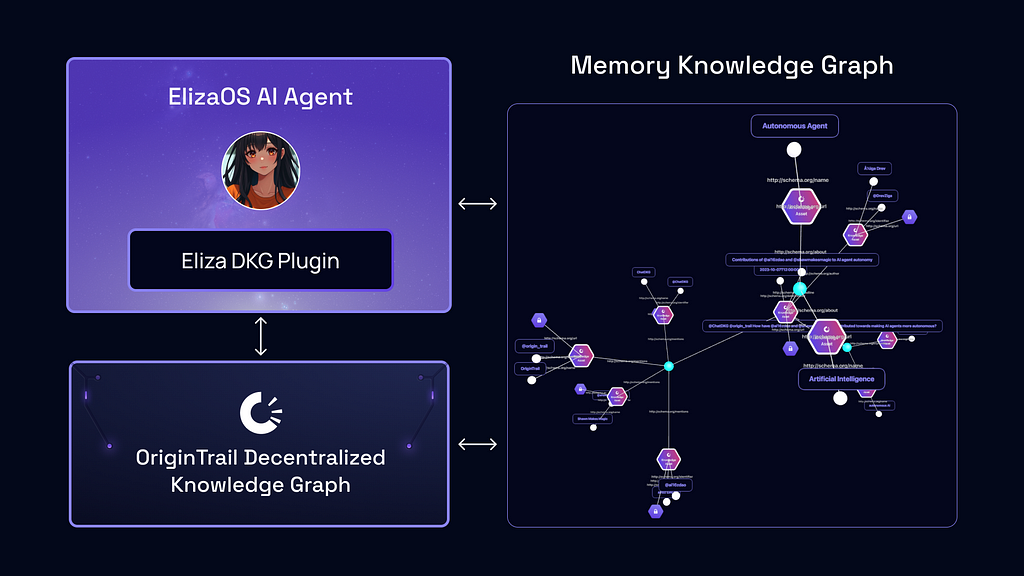
Moreover, ChatDKG invites users to contribute to its memory base, growing and refining its knowledge through direct interaction. This interactive approach leverages the ElizaOS framework’s capabilities to ensure that each exchange informs the AI and enriches its understanding, making it a dynamic participant in the evolving landscape of knowledge.
Talk to the ChatDKG AI agent on X to grow and read his memory!
Bridging trust between humans and AI agents with Decentralized Knowledge Graph (DKG) and ElizaOS… was originally published in OriginTrail on Medium, where people are continuing the conversation by highlighting and responding to this story.