Microsoft Copilot is becoming the interface for how users work with AI across the Microsoft ecosystem. But what happens when you enhance Copilot with the ability to understand and remember structured, verifiable knowledge?
With the integration of the OriginTrail Decentralized Knowledge Graph (DKG) and the Model Context Protocol (MCP), you can build AI agents that reason over live data, contribute to shared memory, and deliver trusted outputs backed by cryptographic proofs.
By extending Microsoft’s AI infrastructure with OriginTrail, you equip Copilot agents with powerful capabilities for knowledge discovery, memory, and collaboration.
What is MCP?
The Model Context Protocol (MCP) is an open standard that defines how language models access and utilize tools and external data sources.
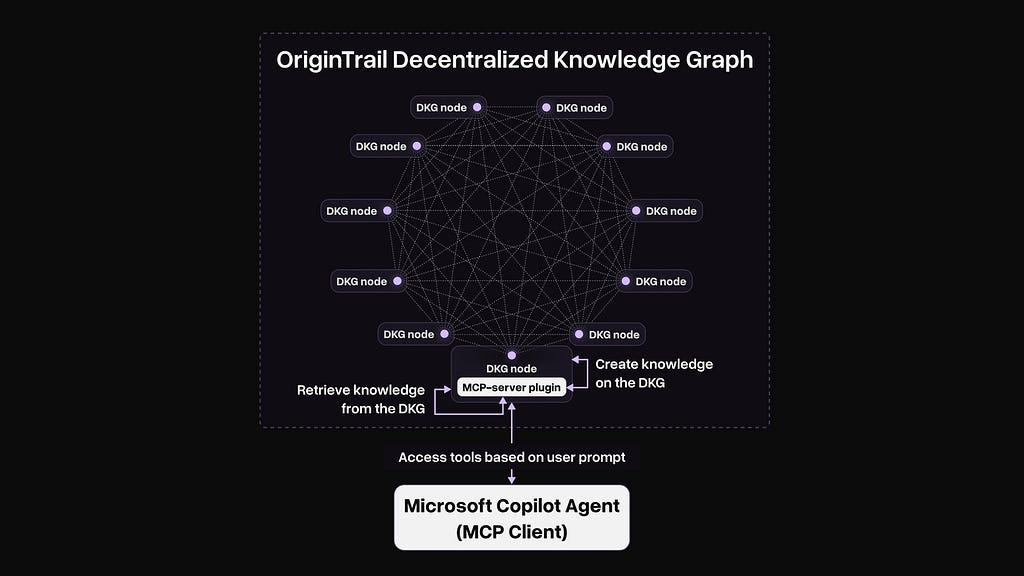
MCP uses a client-server architecture where:
- MCP Servers expose tools and data, both local and remote,
- MCP Clients, such as agents built in Microsoft Copilot Studio, call these tools using a standard protocol.
This architecture makes it easy to build AI systems that are modular, composable, and interoperable across different environments.
What role does the DKG play?
The OriginTrail DKG provides a decentralized layer for structured, verifiable knowledge that AI agents can query, write to, and collaborate over. When connected to an MCP server equipped with DKG tools, agents are empowered to retrieve and build upon interconnected, verifiable knowledge.
AI agents can:
- Retrieve semantically rich knowledge,
- Generate and publish new Knowledge Assets,
- Collaborate on a shared, verifiable knowledge base.
Each interaction is built with data provenance, version control, and ownership in mind. Knowledge is shared, structured, and trustworthy!
Supercharging Microsoft Copilot with verifiable memory!
Through this integration, builders can now connect OriginTrail DKG with custom agents built in Microsoft Copilot Studio.
Here’s what that enables:
- The DKG MCP server runs alongside an OriginTrail DKG Node,
- Custom actions are registered in Microsoft Copilot Studio to access DKG tools,
- These actions can be triggered by agents within environments like Microsoft Teams.
This setup allows Copilot-based agents to access interconnected, verifiable knowledge in real time, and contribute new structured information back into the DKG.
Agents can then:
- Ask precise questions over a structured knowledge graph,
- Write their own memory as reusable Knowledge Assets,
- Store results, update context, and collaborate with other agents.
This integration brings reasoning, verifiability, and memory collaboration directly into Copilot-powered workflows
See it in action!
In the live demo, Jurij Škornik, General Manager at Trace Labs, core developers of OriginTrail, walks us through:
- Running the DKG MCP server with an OriginTrail Edge Node,
- Building a custom agent in Microsoft Copilot Studio,
- Adding custom actions to enable interaction via Microsoft Teams.
The result is a working Copilot agent with full access to decentralized, verifiable memory. Check it out!
As AI becomes central to enterprise workflows, adding verifiability and structure to its memory is essential. Combining OriginTrail DKG and MCP means your agents are working with knowledge that is:
- Structured using open standards (like RDF and schema.org),
- Interconnected across multiple data sources,
- Verifiable thanks to cryptographic anchoring,
- Portable across applications, agents, and ecosystems, such as Microsoft.
This opens the door to new applications in supply chains, research, content management, enterprise collaboration, and more!
Build AI agents with verifiable memory using OriginTrail and Microsoft Copilot! was originally published in OriginTrail on Medium, where people are continuing the conversation by highlighting and responding to this story.