AI can propose the next move. Organizations need to control what happens next and verify the result. OriginTrail Graph Computer brings that control into the DKG. As a neuro-symbolic AI engine, the Graph Computer connects AI model reasoning with trusted knowledge and approved programs that apply fixed rules. Models interpret context and propose actions. Explicit logic checks conditions, while the runtime enforces permissions and records execution.
The new DKG update gives agents and applications a common foundation for acting on knowledge with evidence of what ran, under whose authority, and with what outcome. This creates opportunities across organizations. Teams can automate approved decisions with traceable results, while domain experts, developers, and service providers can turn specialist methods into reusable services. The upcoming NeuroSymbolic AI Marketplace will let them sell these services to customers.
From knowledge to approved action
In the DKG, Context Graphs connect the information a decision depends on: assets, dependencies, changes, policies, and findings. Graph Computer turns that knowledge into action by running approved programs on it. Developers can write these programs in TypeScript, which are compiled to run in an isolated WebAssembly sandbox: a sealed-off environment where a program can't reach anything directly. To read DKG memory or use an external system, a program has to ask the host, the part of Graph Computer that runs it, and the host checks every such action before it happens. Each program is stored as a Knowledge Asset, a versioned record on the DKG with a clear owner. Its approval states exactly which version may run, where it runs, who may run it, which data it can see, and what it's allowed to do.
That clearly splits the work: a domain expert can maintain the rules, a data owner decides how they may be used, and different applications can run the same approved program. For example, an agent, dashboard, and workflow can request one security assessment, each with its own permissions. Reusing a program never hands over control of the data behind it.
Each run starts with a signed request identifying the caller. Graph Computer checks actions that require permission, records the run, and links any smaller runs it starts. Applications must capture the input versions and evidence references used in a decision. Together, these records connect the knowledge, the rules, the authority, and the results.
Approval applies to a particular program version and permitted use. Changing the rules or expanding access needs a new approval, and buying a service cannot override those boundaries. This makes a method reusable across organizations, while each data owner still decides who can use their data and how.
Cybersecurity and digital trust
Continuous assurance is a compelling emerging opportunity for DKG. Security teams need to assess changes as they happen and understand the evidence behind each decision. Graph Computer provides a controlled execution foundation for that process.
A software or hardware update could trigger an approved program to define assessment scope and prepare a bounded probe plan. External security tools perform the probes; further programs evaluate observations, recommend remediation, and assess retests. Actions follow the organization’s permissions and approval requirements.
Update → assess → remediate → retest → verify.
DKG connects the tested version, dependencies, findings, and supporting evidence. With input versions and evidence references captured, Graph Computer’s records help reviewers examine which logic ran and why a decision changed after remediation. Authorized assurance results can be shared across suppliers, operators, and customers, making security decisions easier to investigate.
That evidence also helps teams measure assurance: how quickly updates are assessed, how accurately weaknesses are detected, whether the evidence is complete, and whether retests are repeatable. Verified closure applies to the defined checks and tested version. It does not establish that an entire system is secure.
One DKG architecture
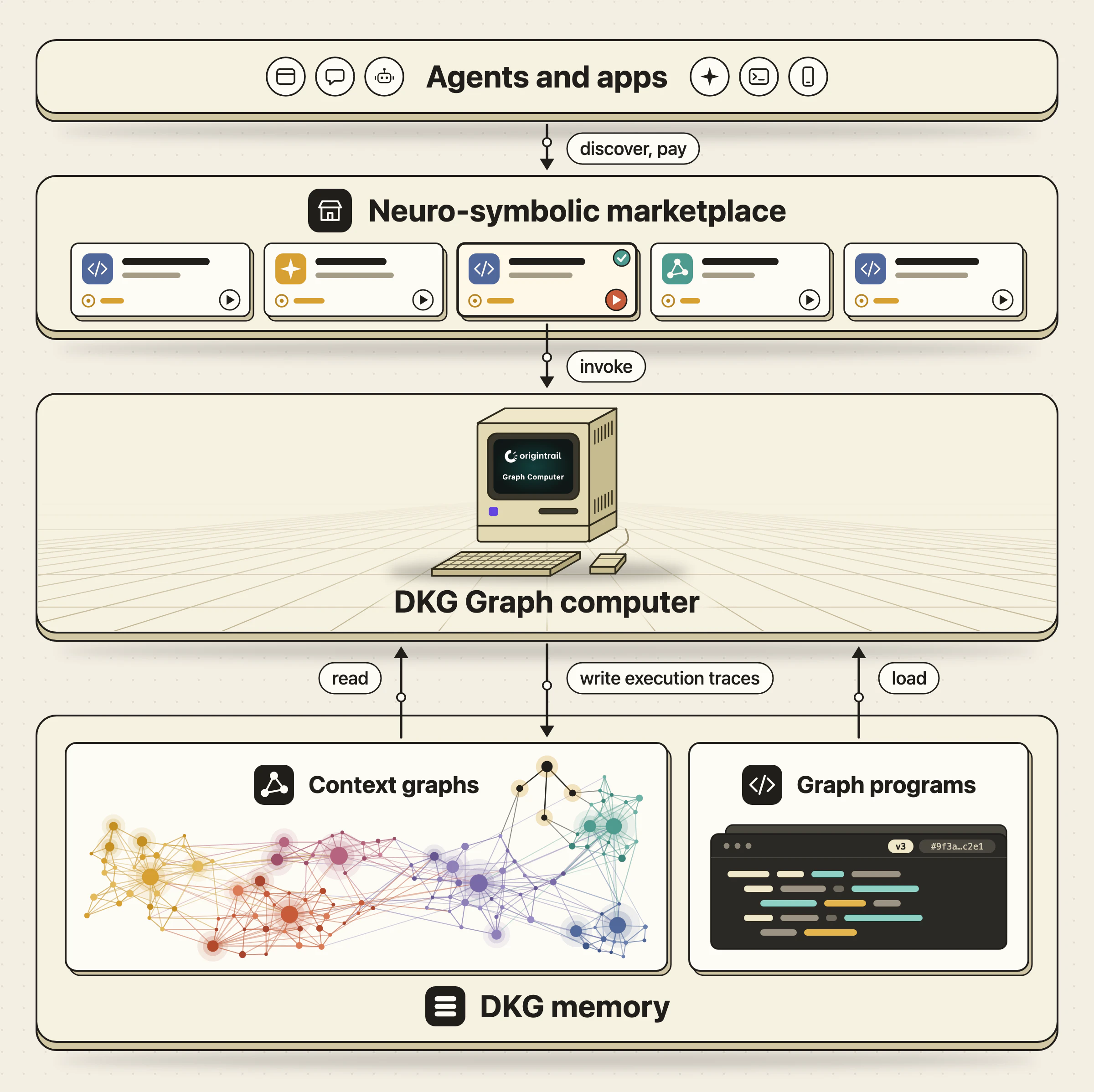
Within DKG, the Graph Computer runs approved programs against the memory they are allowed to use and records each outcome. Inputs and results can stay in local Working Memory, be shared with authorized participants in Shared Working Memory, or be explicitly published to Verifiable Memory. The upcoming NeuroSymbolic AI Marketplace could help users discover and purchase services built on these capabilities.
An engineering foundation for accountable AI
Graph Computer gives executable logic a versioned identity and binds its use to explicit authority. Agents request actions; the runtime enforces the approved boundaries. This connects reasoning to controlled execution without handing an agent unrestricted access to data or tools.
The same pattern supports both a single assessment and a composed workflow: resolve the approved program, check the caller, execute within its capabilities, and retain the outcome. Linked records support investigation and recovery, including when an operation fails.
Traceability makes evidence inspectable; it does not make every input true. Applications still need reliable sources, clear success criteria, and tests for missing data, permission failures, and disputed results. Local execution does not automatically publish records or anchor them on-chain.
A market for verifiable execution
The upcoming NeuroSymbolic AI Marketplace will connect customers with services executed through DKG’s Graph Computer runtime. Domain experts, developers, and service providers can work together to package expertise as approved programs, combining inference with reviewed logic and results customers can inspect.
A security service, for example, could combine an agent’s interpretation of a finding with a program that applies agreed acceptance criteria. Customers would receive a defined assessment with evidence references, rather than an unsupported assurance claim.
Put your Graph Computer to work
From cybersecurity and supply chains to manufacturing, healthcare and financial services, the potential impact is immense. DKG’s integrated Graph Computer could help organizations turn connected knowledge into controlled automation, shared expertise and services with results people can inspect. The opportunity is open to everyone. Businesses, domain experts, developers, and communities can all help shape how knowledge becomes trusted action.
Run a DKG node today and help turn that potential into practical applications. Explore the DKG v10.1.2 release to get started.