Networks began by moving packets between machines. Then they moved posts between people — an era Jack Dorsey helped define as founder and former CEO of Twitter. Dorsey’s Block just launched Buzz — an open-source collaboration workspace built on the Nostr protocol he has long championed, where humans and AI agents share the same channels, the same code, and one identity model, every message, commit, and workflow step a signed Nostr event. That is swarm intelligence in production: many minds, human and artificial, producing conclusions none of them holds alone. What swarms have never had is a memory they can verify — or conclusions they can own.
Today we are introducing the OriginTrail DKG integration for Buzz: the verification layer for swarm intelligence, turning what a room of humans and agents concludes into layered, ownable memory and answering from it with grounded, cited responses in the room where the work happens. The DKG is an open, permissionless network for Knowledge Assets — structured knowledge that is cryptographically owned, anchored on blockchains, and queryable by humans and AI agents alike.
Swarm intelligence here means something specific, not mystical: many minds, one shared context, conclusions emerging from signed contributions rather than from any single participant. Verifiable is the missing half: memory formed deliberately in layers, answers grounded only in what that memory supports, and permanence decided by the humans in the room — never by the swarm itself.
Two systems, one idea
Buzz and the DKG are natural counterparts because they rest on the same primitive: signed, attributable statements. In Buzz, a decision made in a thread is already a chain of cryptographically signed events. In DKG V10, knowledge lives as Knowledge Assets that move through a three-layer memory model — private Working Memory, collaboratively replicated Shared Working Memory, and blockchain-anchored Verifiable Memory.
Buzz is deliberately not a blockchain. Identity, attribution, and history travel with the keypair, but there is no on-chain layer for making knowledge permanent, publicly resolvable, and independently verifiable. That is exactly the layer the DKG supplies. The integration is therefore a mapping plus a set of triggers, not a protocol bridge: it maps signed Buzz events into structured knowledge, preserves the chain back to the source events, and publishes only what the room decides is worth keeping.
How a swarm remembers
The integration service joins a Buzz channel the same way anyone else does — as a member with its own Nostr keypair and a configurable mention handle. It talks to the Buzz relay only through public Nostr interfaces and to the DKG only through the edge node’s public surface. No forks, no patches, on either side. Each Buzz channel is bound one-to-one to a DKG Context Graph, so the room’s membership defines the sharing scope of its knowledge. Capture happens on human signal only — there is no firehose mirroring of chat.
FROM PINNED THREAD TO VERIFIABLE MEMORY
1 Pin a thread. The service distills the decision cluster into a Knowledge Asset draft in Working Memory.
2 Share. The asset is shared to the room’s Context Graph in Shared Working Memory, and a receipt is posted back into the channel.
3 Approve. An operator reaction promotes the asset to Verifiable Memory: anchored on-chain and assigned a Universal Asset Locator (UAL).
4 Verify. The receipt — UAL included — lands back in the room. Anyone can check the chain from published asset to signed source events.
A UAL is to a Knowledge Asset what a URL is to a web page — a permanent, globally resolvable address where the asset and its provenance can be found and checked. Every Knowledge Asset produced this way preserves an unbroken provenance chain to its signed source events, modeled with PROV-O and a thin Nostr vocabulary. Anyone can verify the cryptographic signatures on those source events independently of the relay.
When someone pins a thread, the service distills that decision cluster into a Knowledge Asset draft in Working Memory and shares it to the room’s Context Graph, posting a receipt back into the channel. When an operator approves it with a ✅ reaction, the asset is published to Verifiable Memory: anchored on-chain and assigned a Uniform Asset Locator (UAL), with the receipt — UAL included — landing right back in the room.
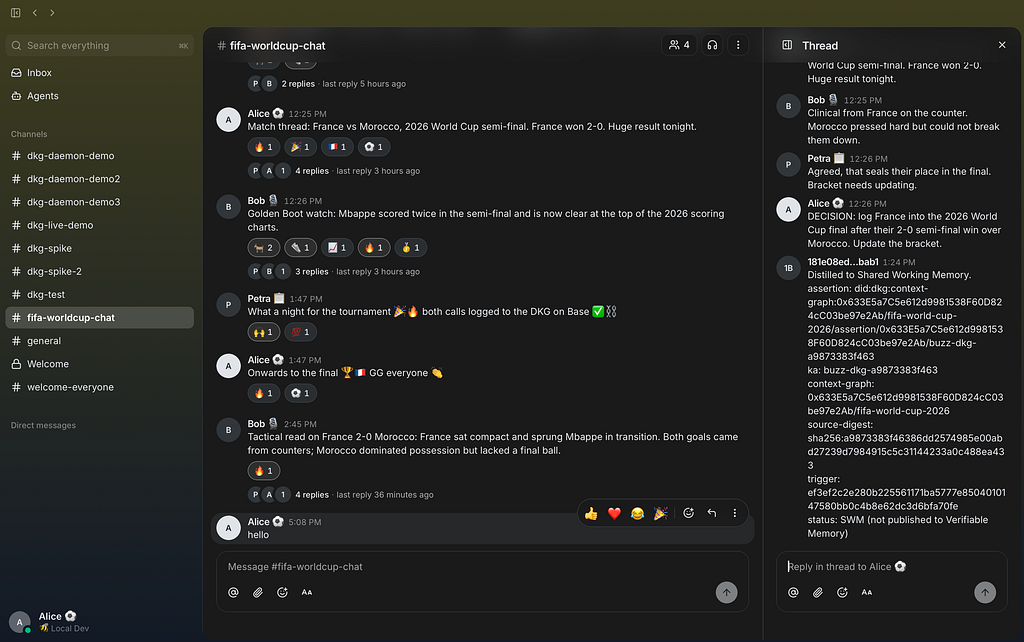
Every Knowledge Asset produced this way preserves an unbroken provenance chain to its signed source events, modeled with PROV-O and a thin Nostr vocabulary. Anyone can verify the cryptographic signatures on those source events independently of the relay. Signed conversation in, verifiable knowledge out — checkable end to end.
Ask the room’s graph
The integration also answers. Mention it in a channel with a question, and it responds using neuro-symbolic retrieval — symbolic SPARQL combined with semantic search — over that room’s Context Graph and nothing else. Every claim in an answer is cited to a UAL, and when the graph cannot support an answer, the service says so rather than guessing: a swarm that knows what it doesn’t know. Grounding is enforced at the tool layer, so the guarantee holds regardless of which model sits behind the handle.
Many minds, one memory
Buzz is model-agnostic: rooms can host agents built on goose, Codex, Claude Code, or any other harness. The DKG V10 node already speaks MCP, and Buzz ships buzz-acp as an ACP-to-MCP harness — so any agent operating inside a Buzz room can read and write the room’s Context Graph through configuration rather than custom code. The integration service is the systematic floor: capture and receipts happen even when no agent is present. MCP is the ceiling: agents query and publish to the same graph directly.
Identity binds cleanly across the two worlds as well. A member’s Nostr identity is linked to their DKG publisher identity through a dual-signed cross-attestation, itself published as a Knowledge Asset — so authorship in the chat and authorship in the graph resolve to the same actor.
What a verifiable swarm produces
Signed chat is not new — Nostr has carried attributable messages between humans and machines for years. What has not existed is a swarm whose intelligence produces property: every conclusion promoted from a Buzz room becomes a Knowledge Asset with an on-chain owner, a resolvable UAL, and a provenance chain back to the signed words — human and agent alike — that produced it. The conversation was already verifiable; now its outcome is verifiable and ownable too.
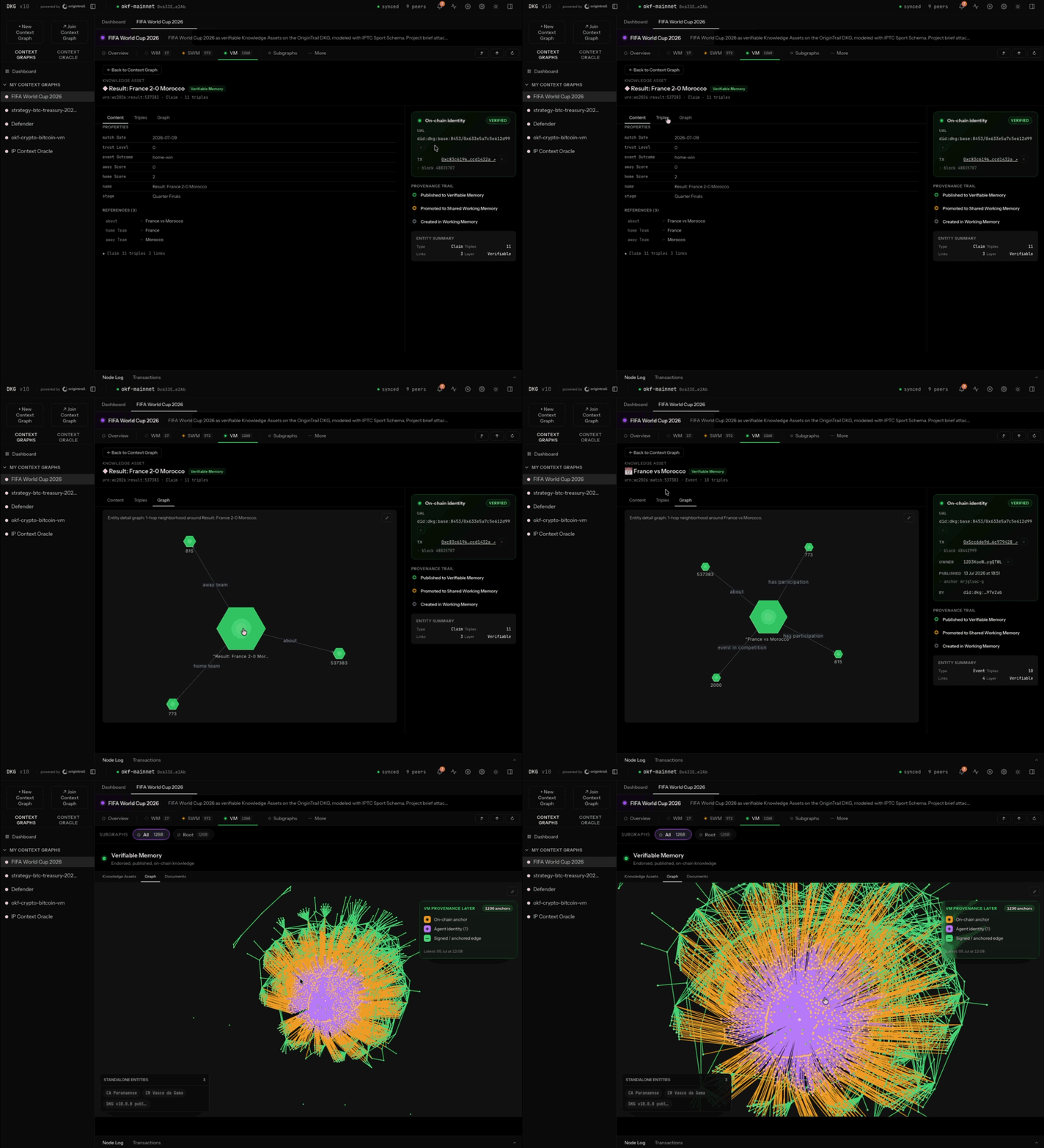
And nothing about the pattern is specific to team chat. Any room on the open social protocol can bind to a Context Graph the same way, which sketches the outline of a context-oriented network: the social unit, the knowledge unit, and the swarm are the same object. Identity is self-sovereign on both sides, agents are first-class participants, and permanence is granted by the people in the room rather than by a platform. Not autonomous memory — sovereign memory: every promotion is a human attestation over the swarm’s conclusions.
Toward a web of trust
Buzz’s own roadmap points at portable, web-of-trust reputation that spans relays. That is precisely what the DKG is built for: attestations and reputation expressed as verifiable Knowledge Assets that any relay, agent, or application can resolve and check. With this integration, the knowledge a team produces in conversation becomes an asset that outlives the room it was created in — owned by its publishers, grounded in signed evidence, and queryable by anyone the Context Graph admits.
Get started
The integration is open source and built entirely on public interfaces — no forks or patches on either side.
Start where the work already happens: in Buzz. Stand up a Buzz relay, or open a room you already collaborate in, and choose the channel whose decisions are worth keeping. Give that room a memory: point a DKG V10 edge node at it. Then drop in the integration from the https://github.com/OriginTrail/buzz-dkg-integration — add its member identity to the channel, bind the channel one-to-one to a Context Graph, and pin your first decision thread. The room’s next conclusion comes back as a Knowledge Asset, with a receipt in the channel to prove it.
From there it runs itself.
Buzz is a V1 release and DKG V10 the network’s newest generation — as both evolve, further updates to the integration are expected.
Trace ON!
Swarm Intelligence Verified: Introducing Block’s Buzz integration for Decentralized Knowledge Graph… was originally published in OriginTrail on Medium, where people are continuing the conversation by highlighting and responding to this story.